Saturday, February 9, 2008

Chapter 11 Vocab


Genetics-the science of heredity, dealing with resemblances and differences of related organisms resulting from the interaction of their genes and the environment.


True-breeding: term used to describe organisms that produce
offspring identical to themselves if allowed to self-pollinate.


trait- specific characteristic that varies from one individual to another.


Hybrid- offspring of crosses between parents with different traits.


Gene-sequence of DNA that codes for protein and thus determines a trait.


Allele-one of a number of different forms of a gene.


Segregation-separation of allenes during gamete formation.


Gamete-specialized cell involved in sexual reproduction.


Probability-likeihood that a particular event will occur.


Punnett Square-diagram showing the gene combinations that might result from a genetic cross.


Homozygous- term used to refer to an organism that has to identical alleles for a particular trait.


Heterozygous-term used to refer to an organism that has two different alleles for the same trait.


Phenotype-physical characteristics of an organism.


Genotype-genetic makeup of an organism.


Homologous-term used to refer to chromosomes that each have a corresponding chromosome from the opposite-sex parent.


Diploid-term used to refer to a cell that contains both sets of homogous chromosomes.


Haploid-term used to refer to a cell that contains only a single set of chromosomes and therefore only a single set of genes.


Meiosis-process by which the number of chromosomes per cell is ut in half through the separation of homologous chromosomes in a diploid cell.


Tetrad-structure containing 4 chromatids that forms during meiosis


Crossing-Over: process in which homologous chromosomes exchange portions of their chromatids during meiosis.


Gene Map-diagram showing the relative locations of each known gene on a particular chromosome.






Wednesday, January 9, 2008

Chapter 10 review

page 243:
1-5
1. Give two reasons why cells divide?
a. cells divide because cells grow large and the more difficult the cell has moving things across the cell membrane.


2 How is a cell's DNA like the books in the library?
a.the more people that move into the town the more they will have to wait for a book(DNA).

3. What is the soultion to the problem caused by cell growth?
a.cell division. To divide into two daughter cells.

4. As a cell increases in size, which increase more rapidly, its surface or its volume?
a. the surface area increases more rapidly than the volume.

5. Calcuate the surface area, volume, and ratio of surface area to volume of an imaginary cubic cell with a length of 4cm.
a. 4cm*4cm*6=96 4cm*4cm*4cm=64 96/64=6:4


page 249
1-6
1.Name the main events of the cell cycle?
a.Interphase, Prophase, Metaphase, Anaphase, Telophase, Cytokinesis.

2. Describe what happens during each of the four phases of mitosis.
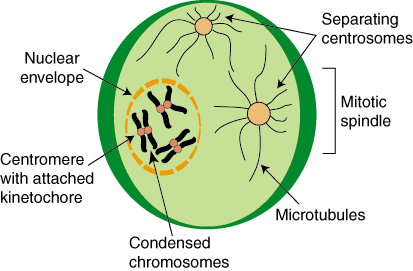
a.Prophase-chromosomes are created and centrioles are seperated.
Metaphase-chromosomes move to center and are connected to a spindle fiber.
Anaphase-the sister chromatids seperate and chromosomes move apart.
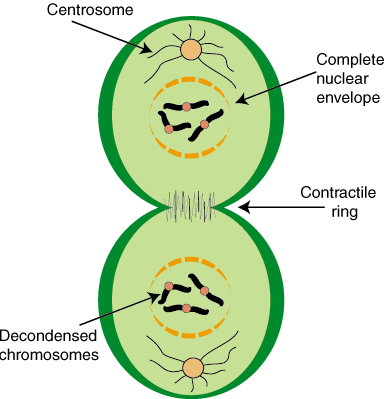
telophase-Two new nuclear membranes are formed.


3. Describe what happens during interphase.
a.Cell gorws and replicates the DNA and centrioles.

4.What are Chromosomes made of?
a.chromosomes are made of two condensed chromatin.

5.How do prokaryotic cells divide?
a.the cytoplasm is divided by a cell plate.

6.How is cytokinesis in plant cells similar to cytokinesis in animal cells? How is it different?
a.similar-divides into two daughter cells
different-plants have a cell plate and cell wall appears.animal cell have the cell membrane draw inward until the cytoplasm is pinched into two parts.


page 252
1-5
1.What chemicals regulate the cell cycle? how do they work?
a.cyclins regulate the timing of the cell cycle.

2.What happens when cell do not respond to the signal that normally regulate their growth?
a.Cancer that form tumors.

3.How do cells respond to contact with other cells?
a.the cell will not grow once it has had contact with another cell.

4.Why can cancer be considered a disease of the cell cycle?
a.Cancer is considered a disease of the cell cycle because scientists need to understand the process of cell division.

5.Write a hypothesis about what you think would happen if cyclin were injected into a cell that was in mitosis.
a.If cyclin were injected into a cell that was in mitosis then the cell will grow a tumor and get cancer.


page 257
1-10
1.The rate at which materials enter and leave through the cell membrane depends on the cell's ...
a. surface
2.The process of cell division results in...
a.two daughter cells
3.Pairs of identical chromatids are attached to each other at an area called the...
a.centromere
4.If a cell has 12 chromosomes, how many chromosomes will each of its daughter cells have after mitosis?
a.12
5.At the beginning of cell division, a chromosome consists of two...
a.chromatids
6.The phase of mitosis during which chromosomes become visible and the centrioles seperate from one another is...
a.prophase
7.Metaphase is best illustrated in which figure?
a.B
8.The timing of the cell cycle in eukaryotic cells is controlled by a group of closely related proteins known as...
a. cyclins
9.In the cell cycle exteral regulators direct cells to...
a. speed up or slow down the cycle.
10.Uncontrolled cell dividion occurs in...
a.cancer

Sunday, January 6, 2008

Vocab Entry

Cell division-
the process by which cells multiply involving both nuclear and cytoplasmic division.


chromatid-
one of two identical chromosomal strands
into which a chromosome splits longitudinally preparatory to cell division.


Centromere-
a specialized structure on the chromosome,
appearing during cell division as the constricted central region
where the two chromatids are held together and form an X shape.


Interphase-
the period of the cell cycle during which the nucleus is not undergoing
division, typically occurring between mitotic or meiotic divisions.


Cell Cycle-
The series of events involving the growth,
replication, and division of a eukaryotic cell.


Mitosis-
cell division in which the nucleus divides into
nuclei containing the same number of chromosomes.


Prophase-
The first stage of mitosis, during which the chromosomes
condense and become visible, the nuclear membrane breaks down,
and the spindle apparatus forms at opposite poles of the cell.


Centriole-
one of a pair of small cylindrical cell organelle
near the nucleus in animal cells; composed of nine triplet
microtubules and form the asters during mitosis.


Spindle-
spindle-shaped structure, composed of microtubules,
that forms near the cell nucleus during mitosis or meiosis and,
as it divides, draws the chromosomes to opposite poles of the cell.


Metaphase-
The stage of mitosis and meiosis, following
prophase and preceding anaphase, during which the
chromosomes are aligned along the metaphase plate.


Anaphase-
the stage of meiosis or mitosis when
chromosomes move toward opposite ends of the nuclear
spindle.


Telophase-
the final stage of meiosis or mitosis, in which the separated
chromosomes reach the opposite poles of the dividing
cell and the nuclei of the daughter cells form around the
two sets of chromosomes.


Cytokinesis-
The division of the cell cytoplasm that
usually follows mitotic or meiotic division of the nucleus.


Cyclin-
any of a group of proteins active in controlling
the cell cycle and in initiating DNA synthesis.


Cancer-
any malignant growth or tumor caused by
abnormal and uncontrolled cell division; it may
spread to other parts of the body through the
lymphatic system or the blood stream.


Friday, January 4, 2008

Biography


I Sir Humphry Davy is an alias for a 15 year old female. I have a mommy and a daddy and two bros in college. I love to sing and dance. I volunteer at my Catholic church with all my church peeps. I love to hang out at Dicks Sporting goods and sit in chair and talk. I lovee to eat twizzlers and raisinets. I love Inta Juice. I am in Loveeeeeeeeeeeeeeee with Johnny Depp and have seen all his movies expect Sweeney Todd. I am a second degree black in Tae kwon do. I am really involved in my church choir. I love Country music, Brad Paisley is my favorite singer and I love Rascal Flatts.