Cell division-
the process by which cells multiply involving both nuclear and cytoplasmic division. 

chromatid-

chromatid-
one of two identical chromosomal strands
into which a chromosome splits longitudinally preparatory to cell division.
Centromere-
a specialized structure on the chromosome, 
appearing during cell division as the constricted central region

appearing during cell division as the constricted central region
where the two chromatids are held together and form an X shape.
Interphase- 
the period of the cell cycle during which the nucleus is not undergoing

the period of the cell cycle during which the nucleus is not undergoing
division, typically occurring between mitotic or meiotic divisions.

Cell Cycle-
The series of events involving the growth,
replication, and division of a eukaryotic cell.
replication, and division of a eukaryotic cell.

Mitosis-
cell division in which the nucleus divides into
cell division in which the nucleus divides into
nuclei containing the same number of chromosomes.
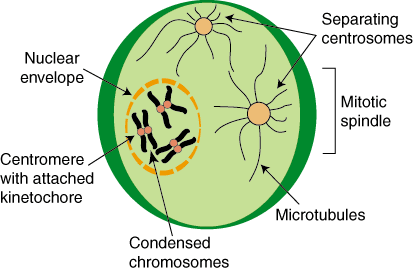 Prophase-
 The first stage of mitosis, during which the chromosomes
condense and become visible, the nuclear membrane breaks down,
condense and become visible, the nuclear membrane breaks down,
and the spindle apparatus forms at opposite poles of the cell.

Centriole-
one of a pair of small cylindrical cell organelle
near the nucleus in animal cells; composed of nine triplet
microtubules and form the asters during mitosis.
 Spindle-
spindle-shaped structure, composed of microtubules,
that forms near the cell nucleus during mitosis or meiosis and,
as it divides, draws the chromosomes to opposite poles of the cell.

Metaphase-
The stage of mitosis and meiosis, following
prophase and preceding anaphase, during which the
chromosomes are aligned along the metaphase plate.
Anaphase-

the stage of meiosis or mitosis when
chromosomes move toward opposite ends of the nuclear 

spindle.
Telophase-
the final stage of meiosis or mitosis, in which the separated
the final stage of meiosis or mitosis, in which the separated

chromosomes reach the opposite poles of the dividing
cell and the nuclei of the daughter cells form around the
two sets of chromosomes.
Cytokinesis-
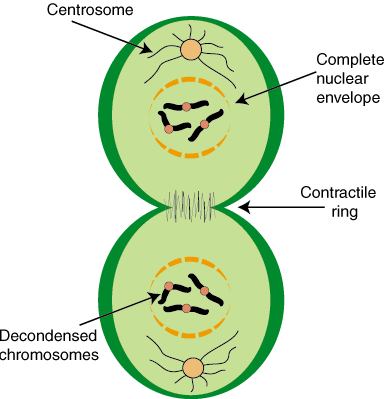
The division of the cell cytoplasm that
usually follows mitotic or meiotic division of the nucleus.
Cyclin-

any of a group of proteins active in controlling
the cell cycle and in initiating DNA synthesis.
Cancer-
any malignant growth or tumor caused by
abnormal and uncontrolled cell  division; it may
division; it mayspread to other parts of the body through the
lymphatic system or the blood stream.

No comments:
Post a Comment